Humanity’s Return to the Moon: Artemis II and the New Space Race
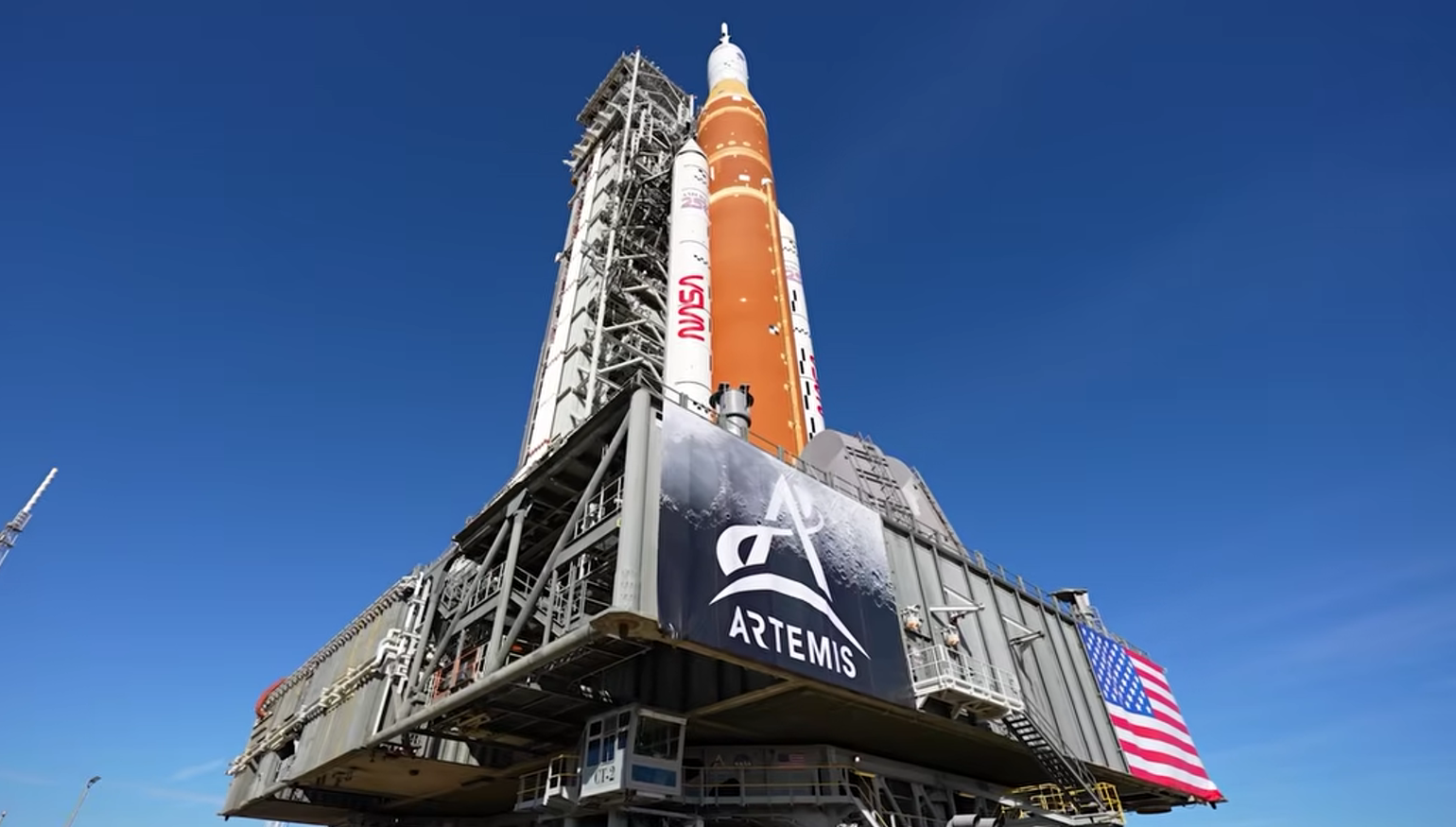
In the next half-century, humankind is about to go back to the Moon. The last preparations of the first crewed lunar mission of the this century are almost over. The Artemis II rocket which was shipped to the Vehicle Assembly Building in the Kennedy Space Center in Florida has been moved to Launch Complex 39B, an initial yet symbolic move in a historic journey.
This moment has an ironic emphasis. It is the most powerful space launch system in the world, with the launch beginning at a slow pace of only 1 kilometer every hour and it takes almost 12 hours to cover the six kilometer distance between the assembly building and the launch pad. However, upon launch, the same space ship will reach the moon and back in approximately 10 days and on the re-entry process to the atmosphere, the Orion capsule will be moving at approximately 40 000 km/h. A ride that starts slower than a bicycle finishes faster than any vehicle that man has ever ridden on.
Since Apollo to artemis: Why are we retrogressing?
The only time mankind visited the moon was in 1972, during the Apollo 17 mission. No manned mission has since since 1963 left low Earth orbit. Throughout the Apollo program, nine missions to the Moon or the Moon orbit were undertaken, 6 landings of astronauts on the lunar surface were made, and 12 humans stepped on another heavenly body.
Nonetheless, Apollo was mostly motivated by the Cold War rivalry which was to overcome the Soviet Union. Artemis, the twin sister of Apollo according to the Greek mythology is motivated by much different reasons.
The space race today does not involve two superpowers any longer. China, Russia and India, Europe, Japan and Canada are now active players. Symbolic flag planting is no longer the objective, but permanent presence. In the 2030s, China and Russia will build a permanent station on the south pole of the moon. India has outlined a schedule of a crews lunar mission to 2040s.
Why the south pole? Since that is the location of water ice, potential sources of nuclear fuel, and long-term strategic benefits. Artemis will be the response of the United States to this new competition, an international initiative to create a stable and permanent human habitation on the Moon.
Artemis II: A Test Critical Mission.
Artemis II is the second step in this ambitious scheme. The Artemis II will not land on the Moon as compared to the missions in the future. Rather, four astronauts will orbit it, as Apollo 8 did in the past, and test all the systems to ensure that there is a human presence on board the ship.
The Moon is not the real goal of the mission, but Mars. Artemis II is an incremental project, it is meant to certify life-support systems, navigation, communication and human endurance in deep space.
The crew members are Reid Wiseman, Victor Glover, Christina Koch and Jeremy Hansen and will be on a journey much farther than man has ever traveled before, about 7,400 kilometers past the distant side of the Moon. It is also a historic move in terms of representation: the first woman and non-American astronaut are included into a deep-space team.
The Rocket To Make It Happen: SLS and Orion.
The Space Launch System (SLS) of NASA is nearly 98 meters high, which is close to 30 stories. During takeoff, it generates approximately 15 per cent greater power than the iconic Saturn V, and is the strongest operational spacecraft rocket ever assembled by humans.
Four RS-25 engines, first invented in the Space Shuttle program, reused to save time, cost, and testing risk are at the bottom. The highest one is the Orion spacecraft, a type of crew capsule that could accommodate approximately 9 cubic meters of habitable space, equivalent to two minivans.
During a period of ten days, four astronauts will eat, sleep, exercise, and work in this tight space altogether. Artemis I Orion without crew tested. It will be the first occasion that Artemis II will put the tested active life-support systems with human on board.
A Trip to Deep Space in 10 Days.
Orion will orbit the earth and then it will be launched toward the moon. During the journey, astronauts will take control of the spacecraft manually, perform docking tests, test the conditions of navigation and communication, and radiation exposure.
In passing behind the Moon, communication with the earth will be temporarily interrupted. Next there is one of the most famous scenes in the world of space exploration: Earthrise- the view of the world coming out of the lunar horizon.
Nevertheless, the astronauts will not be mere spectators. They will conduct in-depth geological survey, crater, surface colour, and surface features, particularly on the far side of the Moon, which has not been studied extensively. The observations will assist in finding landing sites of future Artemis missions.
Radiation, Science and Living Tissue in Space.
Ground break scientific experiments are also on board Artemis II. Some of them include living tissue chips constructed out of the own cells of the astronauts- miniature heart, muscle and nerve tissues that can be used to investigate how deep-space radiation can have an impact on the human body.
Artemis II will go further than the protective magnetic field of the earth, unlike the International Space Station, thereby exposing the crew to a greater amount of cosmic radiation. These sensors, wearable devices and bio experiments will gather essential information which will be used in any future long-duration missions particularly to Mars.
The mission will also launch a number of CubeSats which are made by nations such as Germany, Argentina, South Korea and Saudi Arabia to map the lunar radiation and space weather.
Heat Shield Challenge Solution.
Among the largest technical difficulties came after the Artemis I. In the re-entry, the heat shield of Orion did not act as expected, exhibiting asymmetrical material loss. Though it did not pose any threat to the mission, it was more than allowable risk when it comes to human flight.
Instead of making a new design on the shield, NASA engineers changed the way the re-entry was made, by the means of skipping- a kind of throwing a stone over the water, in order to spread the heat evenly. This variation greatly minimizes the stress on the heat shield during the re-entry of the earth.
A Space Communication New Era.
The NASA optical communication system is based on lasers and can be considered the most exciting technological advancement. Laser communication can be used to transmit data at a speed of 100 times faster as opposed to the traditional radio waves.
This would imply that Artemis II would be able to provide high-definition and real-time video due to almost 385,000 kilometers away, which would change the way humanity looks at space exploration.
More Than a Mission
Artemis II is not just a return to the Moon. It is a test of humanity’s readiness to become a multi-planetary species. It represents international cooperation, technological innovation, and a renewed vision for deep-space exploration.
When those engines ignite, it will not simply be a launch—it will be the beginning of a new chapter in human history.












Post Comment